Strategic mixed-method research for restaurant management software
This project involved mixed-method research I led for a leading international food distribution company and their restaurant management software. I worked with a cross-functional team at a consultancy consisting of a designer, product manager, strategist and junior researcher, along with the client team.
the scenario
The client was going through a digital transformation of its recipe and inventory management software. The current software was outdated, cumbersome and created in the 90’s, and the client knew they needed to refresh to stay competitive.
Project goals:
Compose value statements for both tools
Generate long- and short-term product roadmaps
Identify the minimum viable experience (MVE)
Determine the customer segment to target for MVE
I recommended a large generative study resulting in personas and journey maps as the first step, to build confidence in ensuring that we were solving the right problems with the first prototype designs.
the timeline
During the research kick off meeting with the client and internal team, I gathered research goals and questions, assumptions, target audience criteria, recruiting strategy, and timeline.
The strategist and PM on my team created the above timeline, in part based on the input I provided about research timeline. From this, they were able to determine when we could expect to start prototyping and evaluative testing, following by development of the MVE.
discovery interviews
I led two types of discovery research: short interviews at food conferences, and long interviews with participants recruited via the client sales team and my team at the food shows.
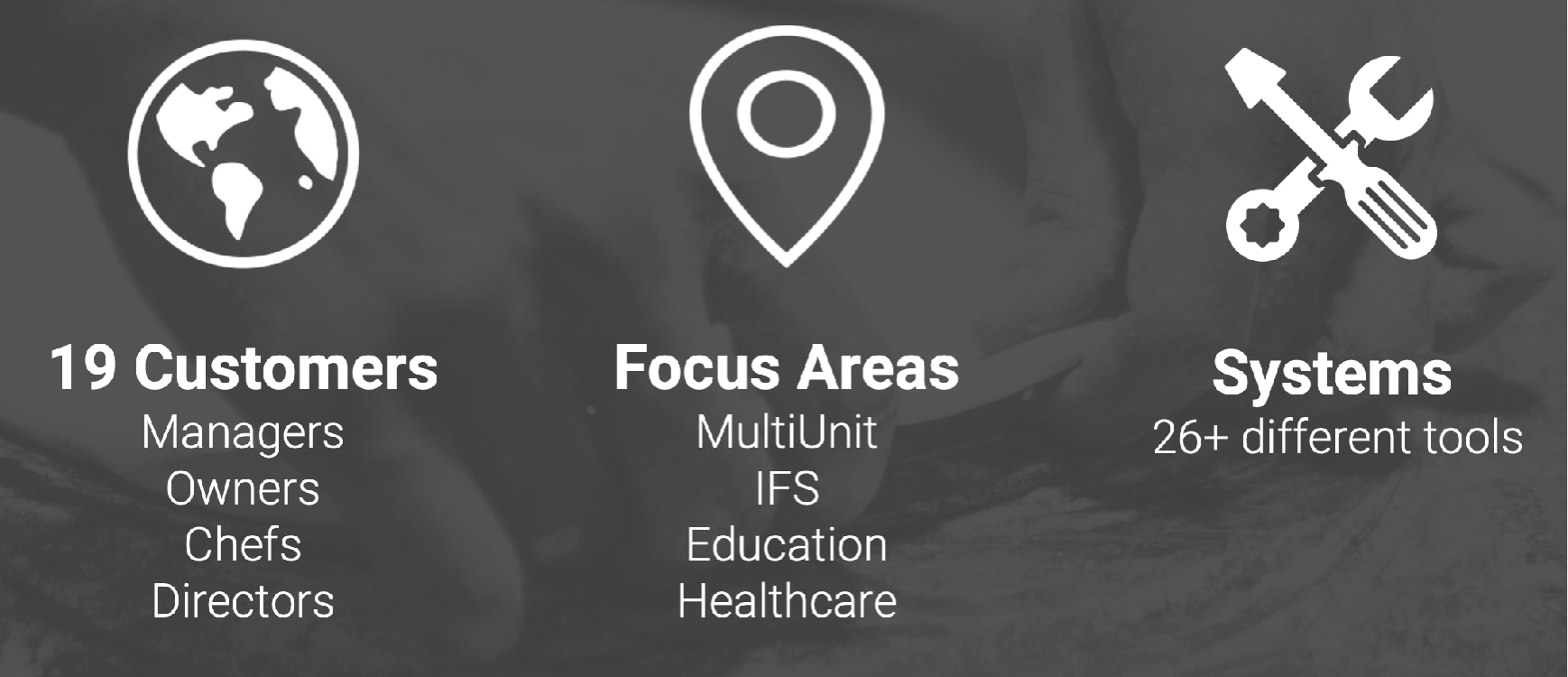
I interviewed 19 customers for the long-form interviews:
Mix of managers, owners, chefs and directors, from –
single mom & pop restaurants
privately owned small local chains
nationwide corporate chains
Mix of tools used:
client’s software
competitor software
their own recipe and inventory management systems
didn’t use any tools
14 interviews were remote, five interviews were contextual inquiries, both consisting of in-depth-interviews, including showing me the space and their tools, and explaining how they interacted with them on a daily basis.
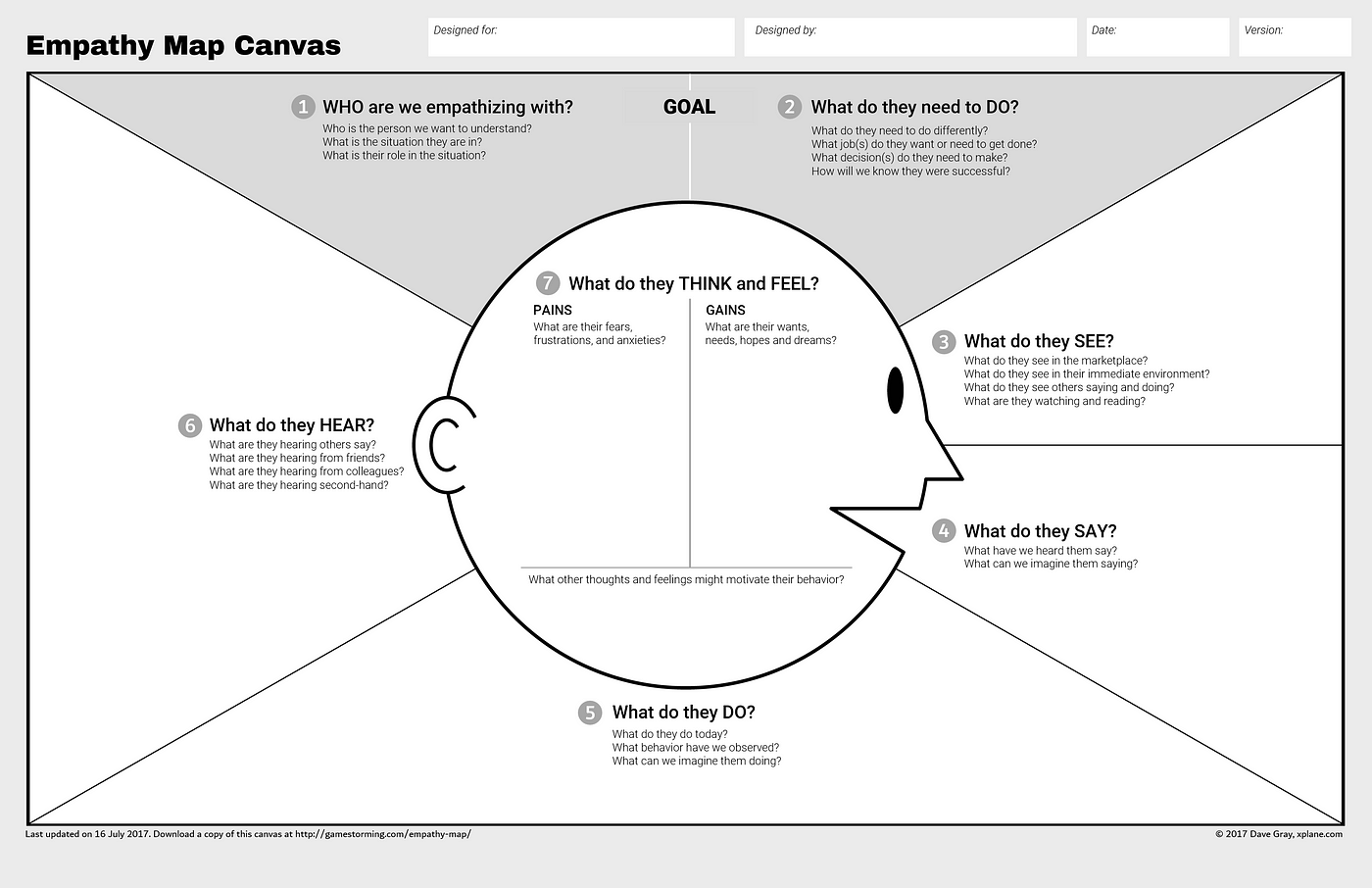
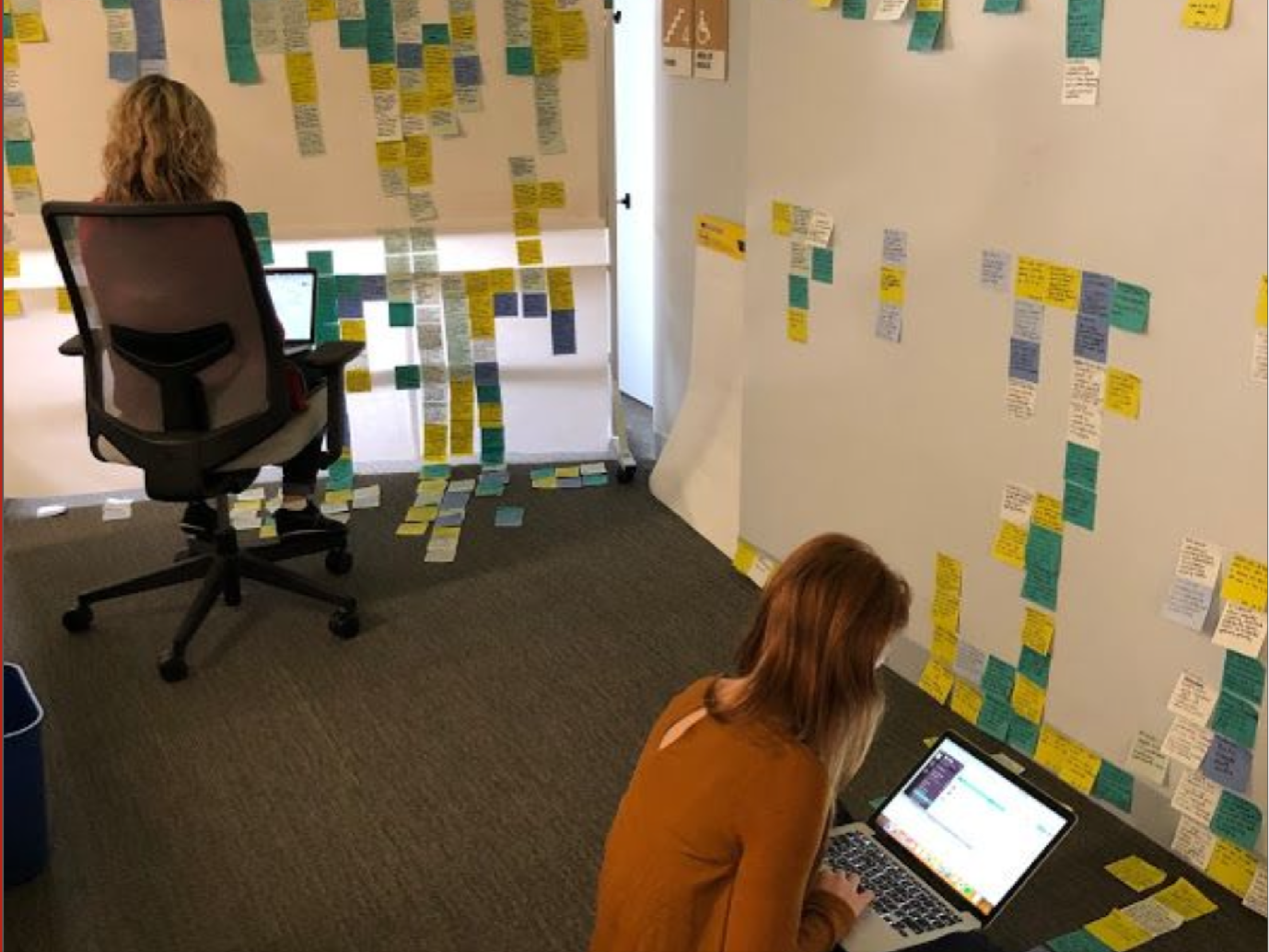
I used empathy maps to take notes on stickies:
analysis & synthesis
Create spectra (behavioral/demographic extremes) and plot participants, look for themes
Form proto-personas based on themes
Create journeys for each proto-persona
Build out final personas based on journey data
personas
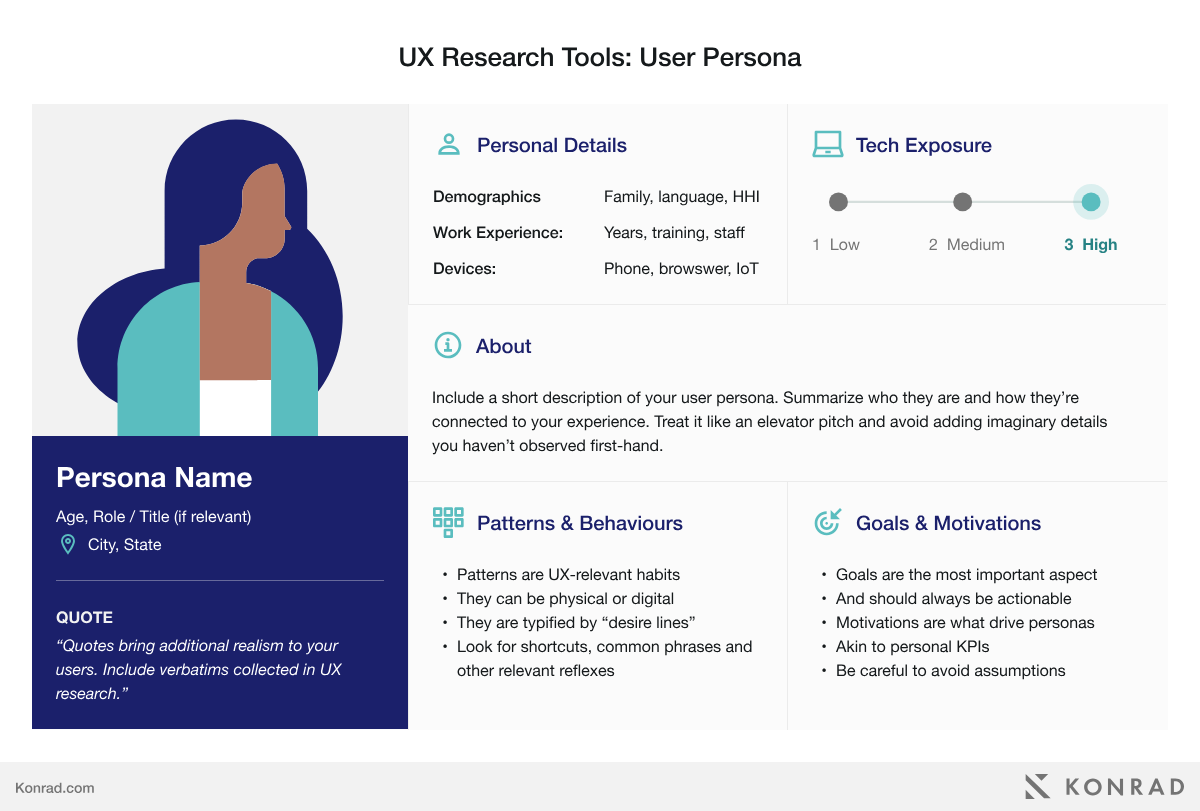
I created three personas, using alliteration between the persona names and their characteristics to help everyone remember them:
One doesn’t use any tools to manage his single mom & pop restaurant
Two uses his own tools – usually in the form of spreadsheets or a competitor’s software – at his privately-owned local chain
Three uses the client’s tools to manage a corporate chain of restaurants
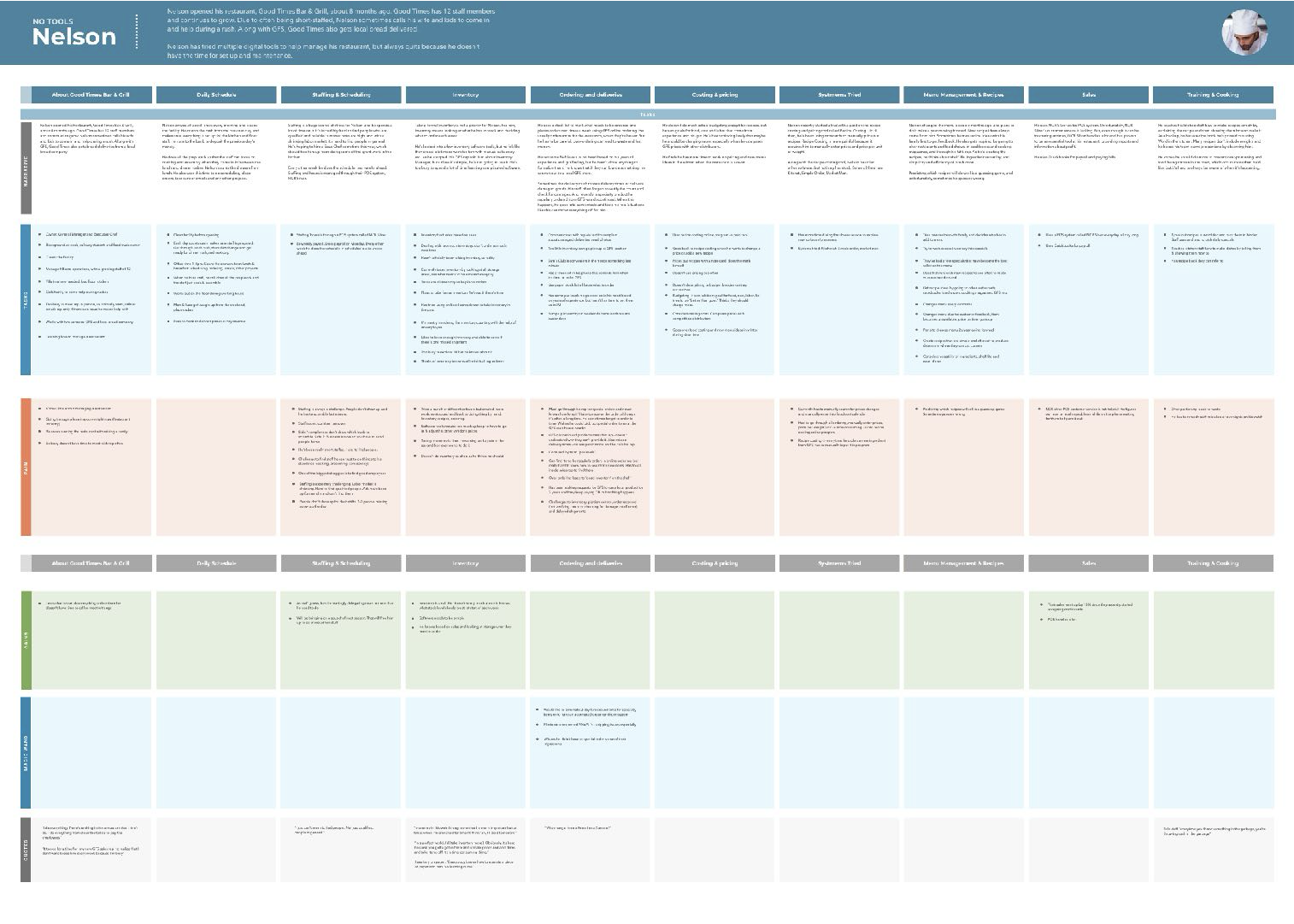
journey maps
I created one journey for each persona, and included the following swim lanes:
Header
Persona name and alliterative key identifier
Summary from persona doc
Journey phase names
Narrative story highlighting pivotal moments
Task list per phase
Pain points associated with each phase
Gains / bright spots per phase
Participant wishes for improvements per phase
Representative participant quotes from interviews
innovation session
Next, my team and I conducted an innovation session with the client. Our goal coming out of this session was to identify which persona we should focus the MVE on, and create prototypes representing the MVE for the restaurant management tools, in order to test them.
Here’s what happened at the session:
I presented the personas and journeys
We broke into 6 groups (2 per persona)
Ideated on solutions to pain points starting with writing out ideas on stickies
Then a round of crazy 8’s to individually explore solutions
Then each chose our favorite sketch, and fleshed it out in a more detailed sketch
Went around the room and presented our ideas to the entire group
Everyone voted on their favorite idea for each persona
Following the innovation session, my team and I discussed the ideas and plotted them on a grid according to business vs user value. We shared this with the client to ensure they were aligned with our thinking.
strategizing
At this point, my team and I were able to define a vision statement for each tool, and determine which persona to focus the MVE on.
I proposed and we decided on one of the personas, due to the fact that it would take the smallest effort to serve that persona’s needs.
I knew one of the personas was happy with his tools, and would take the most convincing to use the MVE.
And the persona that already used the client’s tools would require more advanced features to meet the needs of managing corporate chain restaurants.
We determined that if we started the MVE for the proposed persona, the longterm roadmap would eventually serve everyone:
The persona that already used client tools to manage her corporate restaurant chain would benefit from some of the functionality we build in the MVE, and as the client either incrementally added more features, or chose to partner or buy competitor software, this persona would increasingly see more value.
And the persona that uses his own tools might be convinced to switch from them as features unfold in the new client’s tools.
m.v.e. prototype creation
I worked alongside the designer to create a prototype, ensuring research findings were implemented.
We then held a presentation for the client:
We explained our rationale on focusing on the simple persona for the MVE.
The designer presented the draft prototype.
The client agreed with us on our approach, and gave us feedback on the prototype. We made a few revisions based on that feedback, then we were ready for concept testing.
concept testing
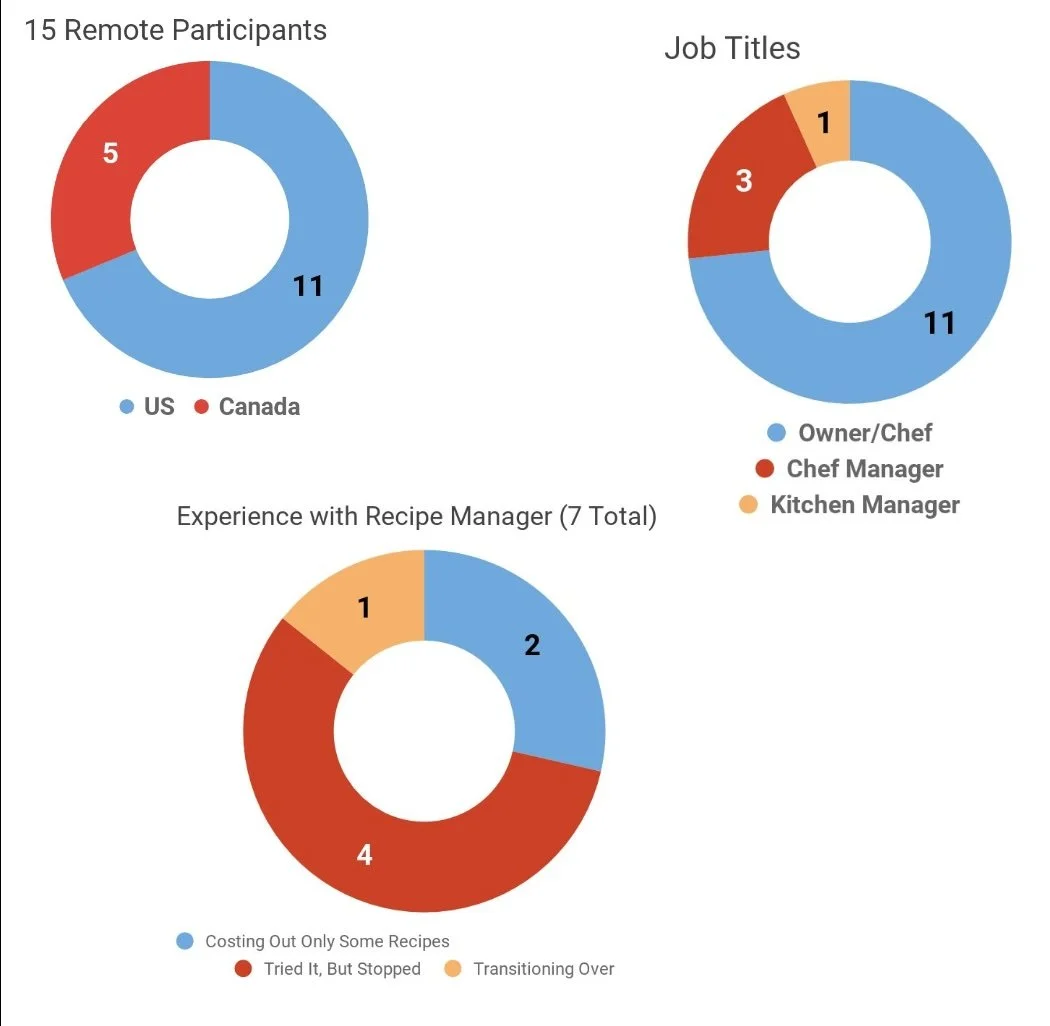
Next, I led a round of concept testing with 15 participants that only represented the persona we were focusing the MVE on. Five had been involved in the discovery research, and the rest were brand new. Interviews were all remote 1-hour sessions.
I started each session with the 10 new participants by asking a series of discovery questions in order to iteratively strengthen our confidence in the discovery study findings. I included one likert rating question asking how much they liked their current process on a scale of 1 to 7.
I then gave participants control of my screen and had them provide feedback on concept elements and took them through think out loud usability tasks.
I implemented a lot of likert rating questions throughout the test in order to create a baseline to compare with future tests on later iterations.
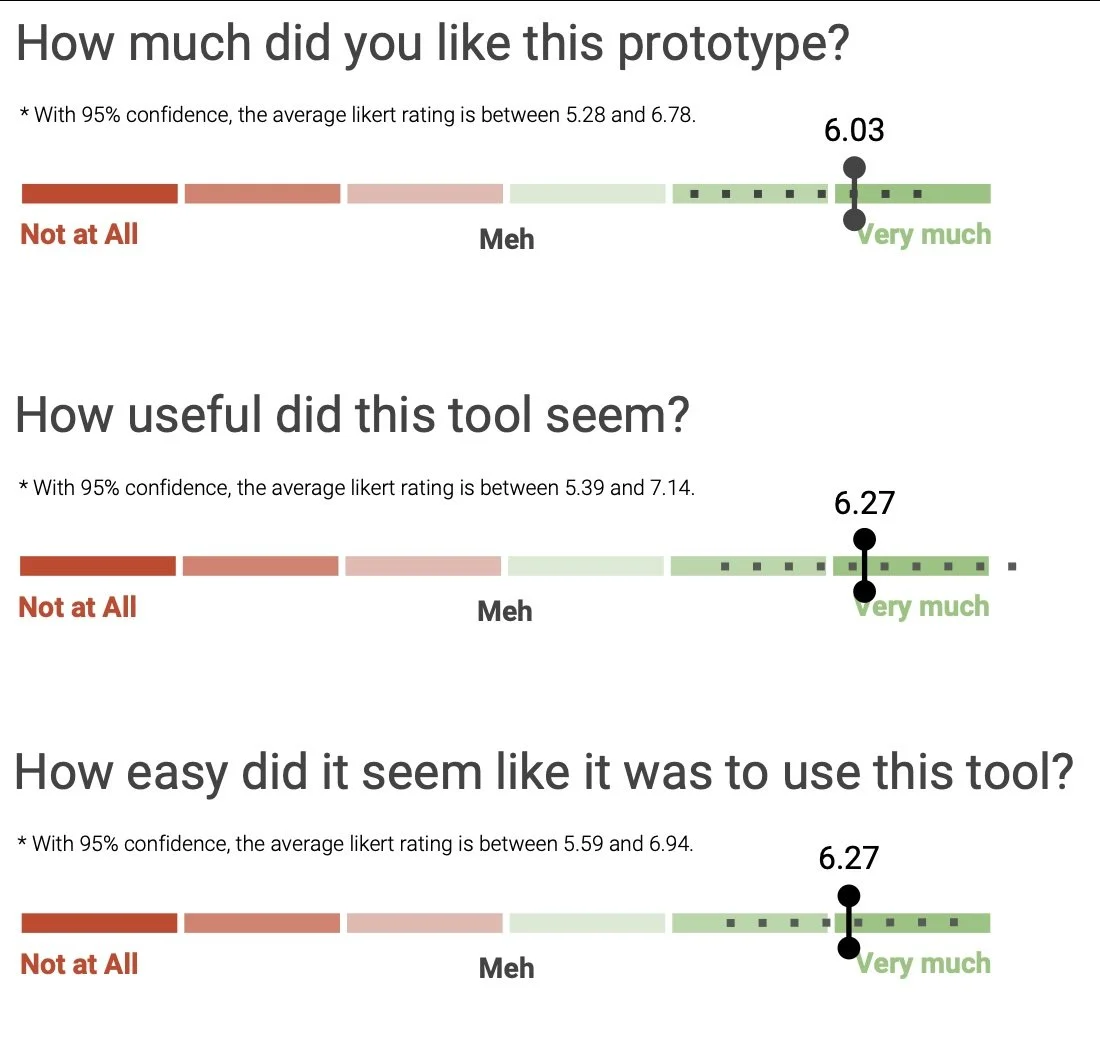
Then, after we had gone through the whole prototype, I asked the 3 likert questions you see here:
With this, I was able to show the client how much more they liked the prototype vs their current process via comparing the likert ratings.
I also quantified success metrics and the ratio of participants that reacted or behaved in certain ways while interacting with the prototype.
After synthesis, I was able to confidently determine where we were successful with our prototype, and what needed improvement, as well as which features should be prioritized:
most valuable features
confusing elements
other strong findings worth noting
what participants thought the tool should do at a minimum to make it worth using
plan moving forward
I left this role to move over to a new position, but before that, I ensured the following was set up for success:
I conducted a knowledge transfer to new researcher who would:
Resume generative research on two remaining secondary customer segments that also needed personas and journey maps
Continue iterative evaluative testing to finalize MVE
Engineers would begin development of MVE on schedule